Corfman Clan wrote:
Kripes, don't make it so complicated. It's not and there is no reason to make it so.
Sorry Corfman Clan to make things seem more complicated. It's what I do!

jcanyoneer wrote:I know the point/day has ZERO support, but this statement shows that it is the simplest system programatically-no factor to multiply by. 1 day is 1 point, 1 week is 7 points, 2 months is about 60 points. If I'm going for a lonely cache and can see it's worth a 91 points, I know its either been out for 91 days if unfound or found once, 182 days if found twice, 273 days if found 3 times...no factor needed. A day still seems like the simplest, straight up unit that doesn't need a factor...just subtract the the 2 dates and be done with it.
jcanyoneer, I see a few advantages with 1 point per day, especially with the "higher resolution" on cache and cacher scores. I liked watching my score move, as well as my hides and finds, and couldn't wait for the next update to see what the new scores were on my caches (hey, I'm a new hider). But personally, I like keeping it around 100/yr, 10/mon, 2/wk. We don't often think of cache age in days (or even weeks) unless we're chasing FTFs... well, maybe that would be a reason to change it.
Speaking of changing everything, let me throw this out there. I don't necessarily think this is the way to go, but this is something we have the ability to control if we want to change how the new system works vs DGP. A lot of people have been commenting that it would be good to hide, not count, or otherwise diminish the value of "power trails" and park and grabs. For example, compare finding one 100-CP backcountry hide with finding one hundred 1-CP power trail micros. Both tasks take a lot of work (I've never done either so I can't say), but the consensus in this group is that the backcountry option ought to be worth quite a bit more (or the power trail option worth quite a bit less, whatever your preference). But according to the DGP calculation, these two scenarios are worth the same (ignoring the effect of CPs changing after finding a cache). But we could "fix" this quite effectively with a small change to the point formula.
The DGP Challenge Point formula is (100 CP/year)*(age in years)/(number of finds), or generically
C * A / x, where
A is the age,
x is the number of finds, and
C is the constant we've been discussing. Just keeping with
C = 100 points/year for comparison purposes, let's consider changing the formula to
C * A / x^n where
n is an exponent of our choosing designed to diminish low value hides. Here's what happens with a one-year-old cache (log-log plot for ease in differentiating the lines):
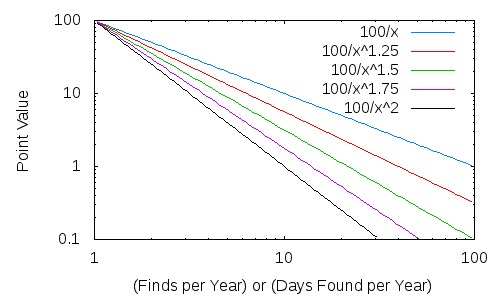
- Table of possible point values for C * A / x ^ n for differing values of n and C*A = 100. Possible method to diminish value of power trail hides from Lonely Caches.
- CP_100A_x^n.png (8.45 KiB) Viewed 14218 times
The blue line is the DGP formula, with
n=1. As you increase
n, the cache loses points more quickly the more times its found. So picking a value for
n could be as simple as answering the question, "How many power-trail micros worth 1 CP on DGP does is take to match a 100 CP backcountry cache?" If the answer is 100, just stick with the DGP formula. If it's 1000, then use
n=1.5. I'm guessing it's somewhere in between. Comments?
Here's a table, if you prefer:
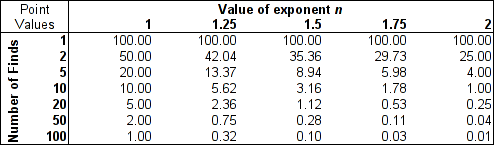
- Family of curves for C * A / x ^ n for differing values of n and C*A = 100. Possible method to diminish value of power trail hides from Lonely Caches.
- CP_100A_x^n_table.png (9.85 KiB) Viewed 14218 times
This could work with number of finds, or it could work with calendar days on which it is found, by changing the meaning of
x. There is no comparable curve with DGP in this case unless you assume every find is on a different day. The consequence of changing
x from "Number of Finds" to "Days on which it is Found" inflates power trails -- which is undesirable -- so having a value of
n > 1 would counteract that switch.
Just an idea.
For reference, I just looked at [gc=GC32B8D]"1500-E.T."[/gc], the last cache on the new ET Highway power trail. As of writing, it's been up 154 days and received 478 Found It logs, giving a DGP score of 0.0883 CPs. If this is typical of the New ET Highway, then it takes 1133 ET caches to match one 100-CP backcountry hide, if individual points are not rounded. But this has been an especially popular destination lately with the resurrection of this trail, so this might be a bad example. I don't know where DGP rounded cache values -- obviously they were reported at whole numbers, but when tallying scores, maybe the fractional points were carried. If cache points are rounded before being summed, than every cache on ET is probably worth 0 CPs and doing the whole trail would net a cacher nothing. As I recall, DGP never said "0 CPs", it was always "<1 CP", which suggests to me that those fraction CPs add up in a finder's score. But we could use rounding to "fix" powertrails. For this example and at this time, rounding to the nearest tenth will overinflate ET caches (this one goes up to 0.1 CPs), so I suggest truncating (rounding down, "floor") to the next tenth or hundredth of a point before summing totals.


 So it will be bumming ATV/UTV rides in the mountains with my inlaws, and rockclimbing/repelling with my coworker friends in the meantime. And I don't think I'll ever ask my dad to borrow his boat! I wore out my hiking shoes this year, but at least I can still go do that now and then!

 )
)


